English
Questions and answers
The questions below are the ones that are hard to answer from an English-language search: how National Health Insurance works at a dentist if you are a foreign resident, what happens if a tooth breaks on a Sunday, and how to book without a phone call. E-Think Dental Clinic is in Pyeongchon, Anyang, and is open every day of the year.
Hours, booking and getting here
What are the opening hours?
The clinic is open every day of the year. Weekdays 10:00 to 21:00, weekends and public holidays 10:00 to 14:00. There is a lunch break from 13:00 to 14:30 on weekdays only. Hours can differ on some public holidays, so please call 031-341-2828 to check before you set out.
Can I come after work?
Yes. Weekday evenings run until 21:00, which is usually the easiest time if you work office hours.
Are you open at weekends and on public holidays?
Yes, from 10:00 to 14:00, with no lunch break. If a tooth starts hurting on a Saturday you do not have to wait until Monday.
How do I book without making a phone call?
Use Naver Booking, or send a message on the clinic's KakaoTalk channel. Email works too. All three leave your question in writing, which helps if you would rather not explain symptoms over the phone in Korean.
Can I just walk in?
Yes, though you may wait longer. If you have severe pain, please call 031-341-2828 before visiting and say so — urgent cases are seen as soon as the schedule allows.
Where exactly is the clinic?
312 Simin-daero, Dongan-gu, Anyang-si, Gyeonggi-do, Room 201. In Korean: 경기도 안양시 동안구 시민대로 312, 평촌칼라힐주차빌딩 201호. It is about a five-minute drive from Beomgye Station and from Indeokwon Station.
Is there parking?
Yes. Parking is free for up to three hours, on floors 1, 3 and 4 of the building the clinic is in.
What should I bring to a first visit?
Your Alien Registration Card, so National Health Insurance can be applied. A note of any medication you take and any conditions you are treated for also helps — blood thinners and diabetes in particular affect dental treatment. If you have X-rays or records from a previous dentist, bring those too.
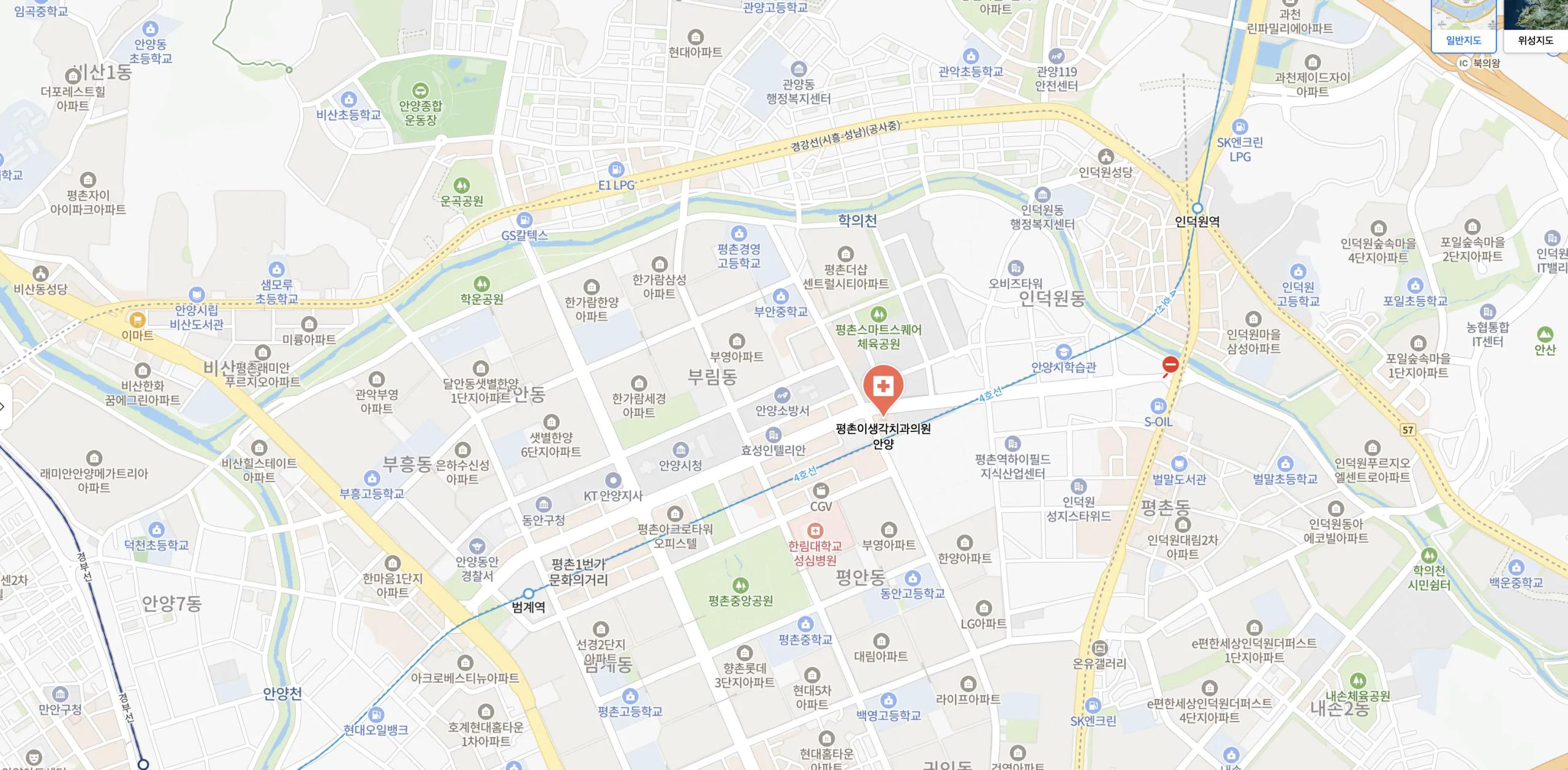 The clinicIndeokwon StnBeomgye Stn
- 평촌이생각치과의원 안양
- E-Think Dental Clinic — the red marker
- 범계역
- Beomgye Station
- 인덕원역
- Indeokwon Station
- 4호선
- Subway Line 4 — the blue line running across the map
- 안양시청
- Anyang City Hall
- 동안구청
- Dongan-gu District Office
- 한림대학교 성심병원
- Hallym University Sacred Heart Hospital
- 평촌중앙공원
- Pyeongchon Central Park
- Full address
- 경기도 안양시 동안구 시민대로 312, 평촌칼라힐주차빌딩 201호 (Room 201)
Cost and payment
What does a first visit cost?
A first visit is an examination, any imaging that is needed, and a conversation about what the options are. What it costs depends on what is done, and much of it is covered by insurance if you are enrolled. Nobody is pushed into treatment after a check-up.
How much is an implant?
It depends on where the tooth is, whether bone grafting is needed, and which fixture and crown are used. Starting fees and what changes them are set out on the fees page, and every published item is on the fee schedule. The figure for your own case comes after an examination.
How much do braces or aligners cost?
It depends on how much the teeth need to move, which appliance is used and how much of the mouth is treated. The starting fees are on the fees page; the plan and its cost are given together after a diagnostic work-up.
Can I pay by card, or in instalments?
Card payment is accepted. If the cost is difficult to manage, say so at the consultation and the payment options will be gone through with you.
Can the price change partway through?
Sometimes. Removing an old filling can reveal decay wider than it looked, and a filling becomes an inlay, or an inlay becomes a crown. When that happens it is explained to you, with the change in cost, before the work continues.
National Health Insurance
Can I use National Health Insurance as a foreign resident?
If you hold an Alien Registration Card and are enrolled in NHIS, dental treatment is covered for you on the same terms as for Korean patients. Bring the card to your appointment.
Which dental treatments are covered?
Check-ups, scaling once a year for patients aged 19 and over, root canal treatment, extractions, gum treatment and amalgam or glass ionomer fillings are generally covered. Patients aged 65 and over are covered for two implants in a lifetime and for dentures once every seven years, and patients aged 18 and under for sealants on certain decay-free back teeth. Eligibility and out-of-pocket costs depend on the treatment and on the insurance rules in force, so please bring your identification and we will check your cover.
Which ones are not?
Tooth-coloured restorations — composite fillings, inlays and crowns — are as a rule not covered, and neither are braces, clear aligners, veneers, whitening, or implants outside the cases NHIS defines. What is covered depends on the treatment, the material and the eligibility criteria, and the rules are set by the Ministry of Health and Welfare and change from time to time.
Does my private dental insurance work here?
Many insurers accept the clinic's documents. Ask at the front desk for the forms you need and allow three to four days — dental insurance paperwork usually cannot be issued the same day, and is prepared once treatment is finished.
If something goes wrong
A tooth suddenly hurts a lot. What should I do?
Call 031-341-2828 first. A painkiller and avoiding anything hot, cold or hard will help in the meantime, and you will be seen as early in the day's schedule as possible.
I broke a tooth.
Keep the broken piece if you have it. If the gum is bleeding, press a clean piece of gauze on it until it stops, and come in as soon as you can.
My crown came off.
Keep the crown and bring it with you — depending on its condition it can sometimes be re-cemented. Do not chew on that side until it has been looked at.
There is a crack in a tooth but it does not hurt much.
How urgent it is depends on how deep the crack goes. If there is any pain or sensitivity, do not leave it — have it looked at rather than waiting to see whether it settles.
What helps until I can get to the clinic?
A painkiller, a cold compress on the outside of the cheek, and avoiding very hot, very cold, hard or spicy food. These ease the symptom; they do not treat what is causing it.
What should I have ready when I call about an emergency?
When the symptom started, where it hurts, any medication you take, and your identification. If a tooth or a piece of one has come out, keep it.
After treatment
How often should I come back for a check-up?
It depends on what was treated, but every six to twelve months is the usual advice. A schedule for your own mouth is set out for you at the end of treatment.
A filling, crown or veneer has come loose or chipped.
Come in as soon as you can, and bring the piece if you still have it — some can be re-bonded. Leaving it can damage the tooth underneath, so call first rather than waiting for the next check-up.
Scaling and prevention
What is scaling, and is it covered?
Scaling removes hardened plaque from the teeth and is the basic preventive treatment for gum health. National Health Insurance covers it once a year for patients aged 19 and over.
Does it hurt?
Usually not much. It can be more sensitive if the gums are already inflamed. Anaesthetic is not normally used, but it can be if the gums are tender.
Why do the gaps between my teeth feel larger after scaling?
Yes. The space was filled by the deposits that have just been removed, so what you are feeling is the actual shape of your gums.
My gums bled a little afterwards.
That is common when there is inflammation in the gums, and it usually settles quickly.
Anything to avoid on the day?
Skip very hot, cold or spicy food that day and brush gently. Any sensitivity usually eases within a few days.
Does frequent scaling wear the teeth down?
No. Scaling does not wear or weaken teeth; it helps keep the gums healthy. How often it is worth doing depends on the state of your gums, commonly between every six and twelve months.
Will scaling make my teeth whiter?
Surface staining comes off, so teeth can look brighter, but scaling is not whitening — it does not change the colour of the tooth itself.
Can I have scaling while pregnant?
Yes, at a suitable point in the pregnancy. Tell us you are pregnant at the consultation and it will be planned around that.
Insurance, in short
If you hold an Alien Registration Card
Foreign residents enrolled in Korea’s National Health Insurance (NHIS) are covered here the same way Korean patients are. Everyday dental care — check-ups, scaling (covered once a year for patients aged 19 and over), fillings, root canal treatment, extractions and gum treatment — is generally covered, so you pay only the patient share.
Cosmetic and elective work — veneers, whitening and most orthodontic treatment — is not covered, and implants are covered only in the limited cases NHIS defines. Coverage rules are set by NHIS and change from time to time, so please bring your ARC and let us check what applies to your treatment before you decide.
Language
If you are worried about the language
Consultations are conducted in Korean. A few things make a first visit easier: send your questions ahead on KakaoTalk or by email so they are on the record before you arrive, bring a written note of your symptoms and any medication you take, and bring a friend, colleague or family member to interpret if you would like to. Nobody will rush you through the explanation.
Have another question?
Send the question ahead on KakaoTalk or by email and it will be on the record before you arrive. If it is about cost, the fees page covers what changes the figure and the fee schedule lists every published item.
- Mon – Fri
- 10:00 – 21:00
- Sat, Sun & holidays
- 10:00 – 14:00
- Lunch break
- 13:00 – 14:30 (weekdays only)
This page is general information about dental care, not a diagnosis or a treatment plan. What is right for you depends on an examination. Please speak with a dentist before deciding on any treatment.